
For hospitals and cardiac rehab teams
Text support for heart patients in the weeks after discharge.
Constance replies to patients from their own discharge plan and passes other questions to your care team. We're talking with hospitals about a first pilot.
In an emergency, call Triple Zero (000).
Words on screen in clinic-demo.mp4 (45 seconds). The audio is music and message sounds only; there is no speech. Every patient shown is fictional.
Constance.
Text support for heart patients in the weeks after discharge.
Answers from each patient's own discharge plan. Everything else goes to your team.
Demo · fictional patients
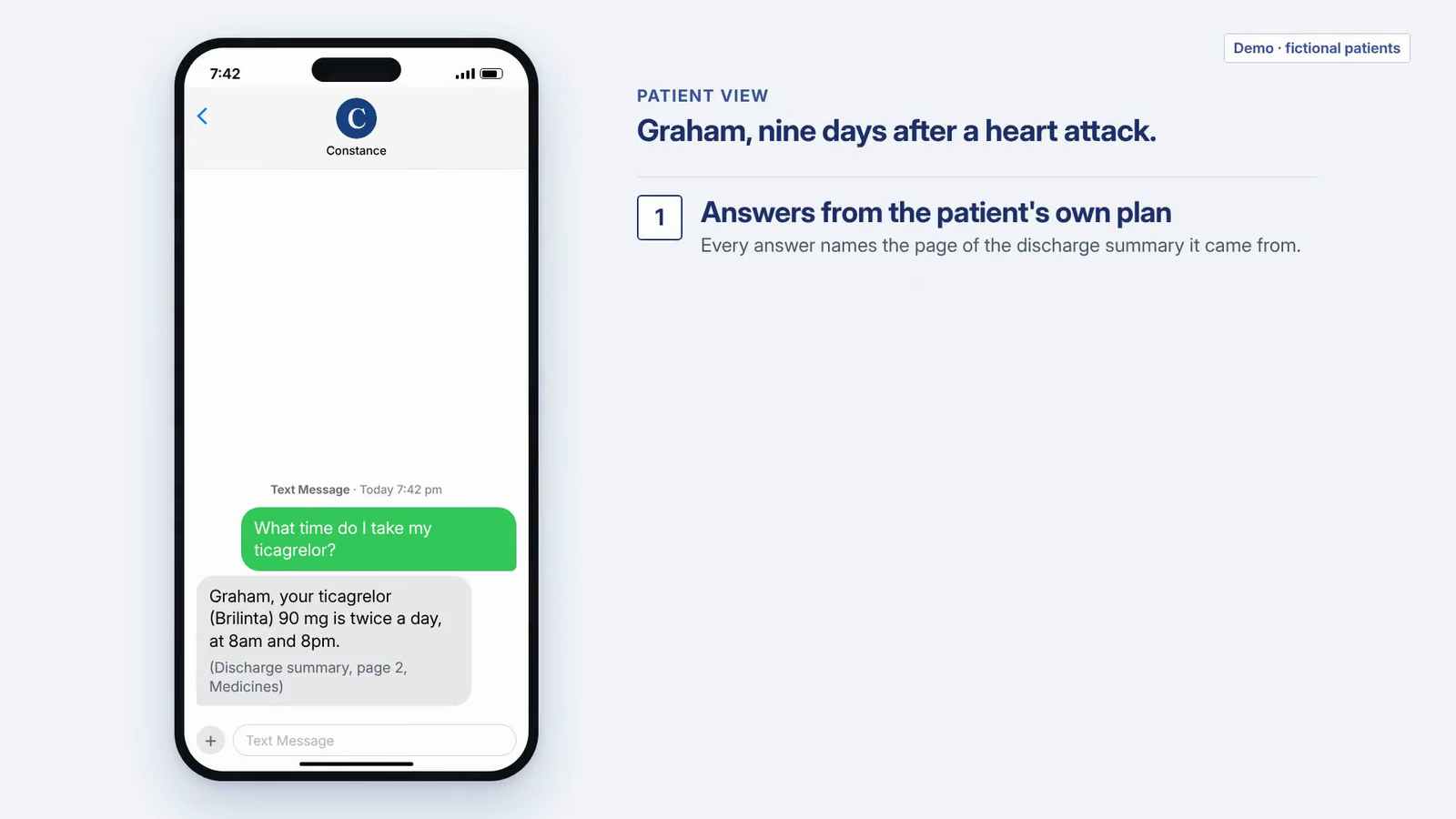
Patient view. Graham, nine days after a heart attack.
Text Message, Today 7:42 pm. Graham: What time do I take my ticagrelor?
Constance: Graham, your ticagrelor (Brilinta) 90 mg is twice a day, at 8am and 8pm. (Discharge summary, page 2, Medicines)
1. Answers from the patient's own plan. Every answer names the page of the discharge summary it came from.
Graham: Can I skip my ticagrelor tonight?
Constance: I'll pass this to your care team. I'm an AI assistant working with them and I can only answer from your discharge plan. If you have chest pain, trouble breathing or have fainted, call 000.
2. Everything else goes to the care team. Dose changes and anything off the plan never get an AI answer.
Graham: I've had chest pain for 15 minutes
Constance: Call 000 now if you have chest pain, trouble breathing or have fainted. I'm an AI assistant: your care team will see this message, but this service isn't watched 24/7, so please don't wait for a reply.
3. Symptoms get a fixed 000 reply. The same wording every time, and the team sees the message.
Clinician view. The care team's inbox.
Constance · Care team inbox. Demo, fictional patients.
Patients: Graham Wilson, Day 9 · heart attack, one stent (labels: Mentions symptoms; Passed to care team). Mei Chen, Day 4 · stable angina, one stent.
Graham's conversation, with labels under his messages: Plan item: med-ticagrelor; Fact-checked by code; Passed to care team; Mentions symptoms.
4. Every answer shows its source. The plan item it used, checked by code before it's sent.
Check-in, day 9. Tablets taken: Yes. Walked: 15 min. Patient-reported.
5. A daily check-in. Tablets and walking, logged as patient-reported.
From your care team: Hi Graham, it's the cardiac nurse. Please keep taking your ticagrelor tonight, we'll call you this afternoon.
6. Your team replies in the thread. It reaches the patient as a text from the care team.
Safety. Safe by design.
It never changes a medicine or a dose. Questions about changing, skipping or stopping one always go to your team.
The AI answers only from the plan. Code checks every answer. A dose or time that isn't in the plan is never sent.
Symptoms never get an AI reply. A fixed call 000 message goes out, and your team sees it.
Privacy. Private by default.
Stored in Australia. On Amazon Web Services in Sydney. The AI runs in Australia too.
Working towards SOC 2. An independent security audit is on our roadmap.
Patients agree first. A consent text before anything starts. Reply STOP at any time to opt out.
Ask us for a live demo.
admin@constancehealth.au
constancehealth.au
The gap after discharge
Patients go home with a discharge summary written in clinical language. Questions about tablets, appointments and activity come up at home, often after hours.
Those questions don't always reach the care team in time. Some people end up back in hospital.
1 in 5 unplanned readmissions within 30 days were potentially avoidable
General medicine patients at one South Australian hospital, 2022 data. Background research, not a Constance result. Sharma et al., Australian Health Review, 2025.
How it works
How Constance is designed to work, in four steps. The demo shows each one with fictional patients.


Start from the discharge plan
Constance turns the patient's discharge summary into a plain-language plan: medicines, appointments and activity.
Reply by text, from that plan
When the patient texts a question, Constance replies only from their plan and names the part of the summary it used.
Pass other questions to the team
Questions about changing a medicine go to your care team. Messages that mention symptoms get a fixed reply to call 000.
Check in each day
A short daily text asks about tablets and walking. Replies are logged as patient-reported, for your team to see.
Built with limits
Constance is designed to work inside the plan your team wrote.
- It never changes a medicine or a dose.
- Code checks every reply against the plan before it is sent.
- Messages about symptoms never get an AI reply.
- Patients agree by text before they get replies from their plan or daily check-ins, and can reply STOP at any time.
Where we are
Constance is a Melbourne startup founded in 2026. We're starting with coronary artery disease, such as patients going home after a stent.
We're talking with hospitals, cardiac rehab teams and clinicians about a first pilot. No pilot is running yet.
Talk to us about a pilot
Tell us about your service and we'll walk you through the demo.
Or email admin@constancehealth.au
Please don't include any health or patient information.